
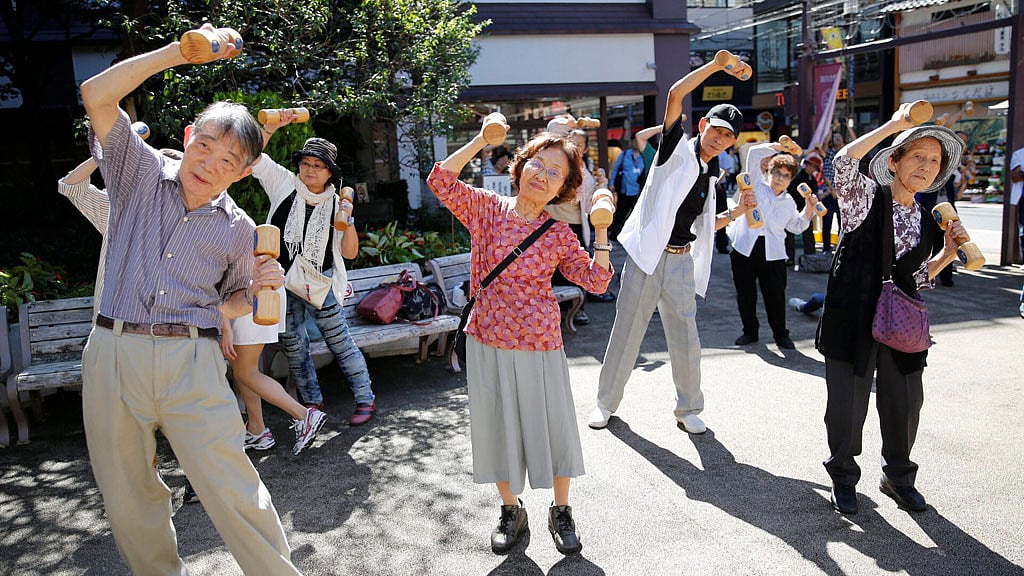
Women account for 88 percent of centenarians, which contrasts sharply with Japan’s stubbornly low fertility rate
Published : 16 Sep 2026, 07:04 PM
Japan’s population of people aged 100 or above has crossed the 100,000 mark, making it the world’s largest centenarian population.
The number of centenarians reached 107,677 this year, nearly 8,000 more than in 2025, according to the health ministry.
The figure has climbed every year since the government began its annual survey 56 years ago, reports The Independent.
Women account for 88 percent of the total, with 94,298 aged 100 or more.
The Independent reports Fuyo Kishimoto, 114, is Japan’s oldest woman, while Hikaru Kato, 112, is the oldest man.
"I am very pleased that so many people are remaining active and healthy for so long," health minister Kenichiro Ueno was quoted as saying by The Independent.
He attributed the trend to advances in medicine and technology, while cautioning that the country’s ageing population was placing pressure on its social security system.
Japan remains among the world’s longest-living nations. World Bank data show average life expectancy stood at 84 in 2024, compared with 79 in the US.
The latest figures were released ahead of the "Respect for the Aged" holiday, when the government sends letters and traditional sake cups to people turning 100.
The Independent reports that centenarian counts have faced questions in different countries because of inaccurate records, missing birth certificates and other gaps in civil registries.
A Japanese government audit in 2010 found more than 230,000 people listed as being at least 100 whose whereabouts could not be confirmed or who had died decades earlier. Some cases raised suspicions that deaths had been concealed so relatives could continue receiving pensions.
The longevity boom is unfolding alongside a deepening demographic squeeze. Despite the country’s extraordinary longevity, its overall population continues to contract.
The population of about 123 million is projected to fall to 87 million by 2070 according to Japan’s National Institute of Population and Social Security Research.
The fertility rate fell to a record-low 1.14 last year, far below the roughly 2.1 required to maintain a stable population, reports The Independent. Meanwhile, people aged 65 and over already make up about 30 percent of the population, a share expected to approach 40 percent by 2070.
Prime minister Sanae Takichi has called the demographic crisis a "quiet emergency". Despite subsidies and programmes designed to encourage childbirth, the birth rate has yet to recover.
The Independent reports that experts point to several contributing forces, including declining marriage rates, women’s growing participation in the workforce, and the escalating cost of raising children.