“If all the trees planted over the past 20 years had survived, Bangladesh would look like a vast forest,” says CAPS Chairman Ahmad Kamruzzaman Majumder, questioning whether plantation drives are being properly monitored
Published : 19 Sep 2026, 01:16 AM
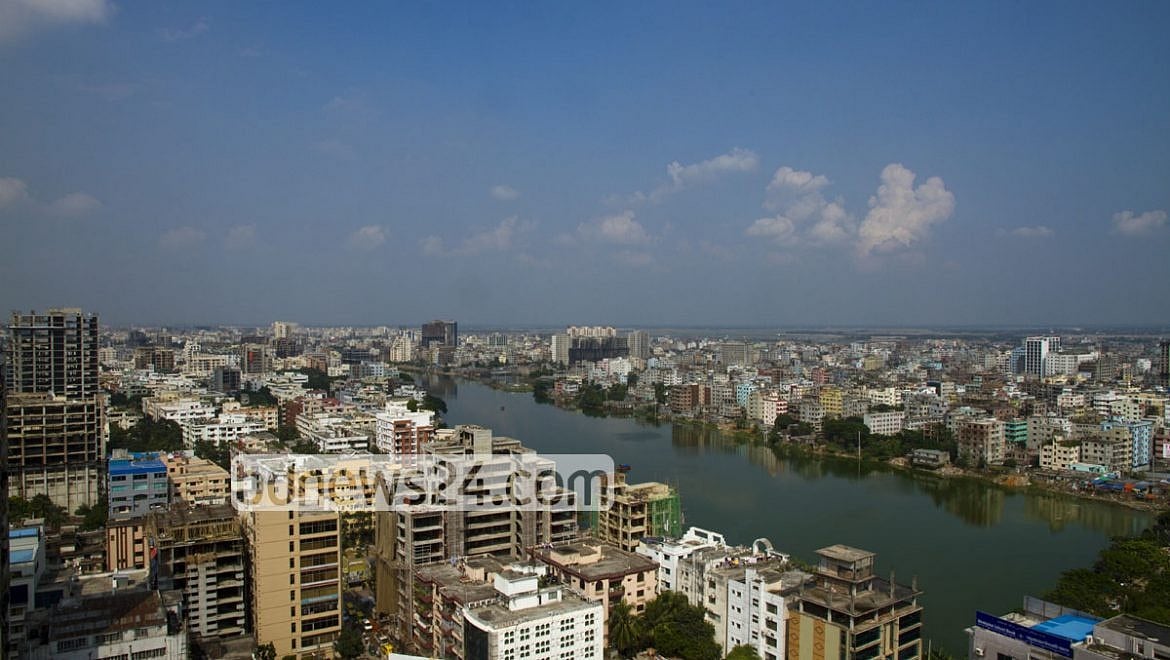
Dhaka is rapidly trading trees, wetlands, and open land for concrete in an alarming transformation researchers warn is making the capital hotter, more polluted, and increasingly vulnerable to environmental shocks.
Urban planners and environmental experts welcome the government’s push to plant more trees, but say simply putting saplings in the ground is not enough.
Where they are planted, what species are chosen, and whether they survive will determine whether the effort makes any real difference.
A new study by the Centre for Atmospheric Pollution Studies (CAPS) shows just how much Dhaka has changed.
The city lost 31 percent of its tree-covered area in the decade to 2025. Water bodies shrank by 47 percent, while built-up land expanded by 50 percent.
According to the CAPS report, “Land Use and Land Cover Change Analysis of Dhaka City: 2015–2025”, vegetation covered 3,784.19 hectares in 2015, or 12.52 percent of the city’s total area.
By 2025, that had fallen to 2,608.99 hectares, or just 8.63 percent.
The private research organisation published the report in August after analysing maps and related land-use data.
CAPS Chairman Ahmad Kamruzzaman Majumder said the balance between built-up areas, water bodies, vegetation, vacant land, and grassland had shifted dramatically.
The sharpest change, he said, was the rapid expansion of construction at the expense of water bodies, green areas and open land.
“The loss of water bodies and vegetation will increase the risks of waterlogging and higher urban temperatures,” he said.
“Future urban planning must therefore control unplanned expansion, protect existing water bodies and green areas, create new open and green spaces, and ensure environmentally sustainable land management.”
What It Looked Like from 1991 to 2016
The decline did not begin in the past decade.
A 2019 study by Dhaka University geography and environment researcher Mohammad Sofi Ullah and MSS student Ismat Inan traced changes in land use across 39,000 hectares of the Dhaka metropolitan area.
Their paper, “Land Use and Land Cover Change in Dhaka Metropolitan Area During 1991–2022”, found that green cover stood at 3,800.16 hectares in 2016.
It had been 4,900.27 hectares in 2011 and 7,200 hectares in 2001.
In 1991, the figure was 5,800.64 hectares.
Sofi Ullah, now a professor at the Department Geography and Environment, said much of what remains green today is concentrated in the eastern part of Dhaka, where the land is lower.
“In 1991, many areas were water bodies or green land,” he said. “Those places have now become housing, buildings — everything has turned into concrete.”
What greenery remains, Prof Sofi Ullah said, is often limited to trees on road dividers or within residential areas.
Even designated green spaces are not always managed properly.
“Open land, agricultural land and bushland will also disappear in future if this continues,” he warned. “Those areas are already declining sharply.”
He pointed to Bosila as an example.
“There used to be water bodies there, blue areas. Now almost the whole place is built up.”
The difficulty now, he said, is finding space for new greenery.
“Where will you plant new trees? That needs deep planning. It needs a framework.”
Protecting mature trees should come first, Prof Sofi Ullah said, but the city must also find new “breathing spaces” for planting.
Recovering and protecting the banks of water bodies, canals, and rivers should be part of that effort.
Prof M Shafiq-Ur Rahman of Jahangirnagar University’s Department of Urban and Regional Planning also sees the shrinking green cover as a growing threat.
“Since independence, both greenery and wetlands have declined every year,” he said.
“As the population has grown, these areas have shrunk. The decline has accelerated over the past 10 to 15 years.”
The loss is not confined to Dhaka, he said, pointing to pressure on forest areas in Gazipur and elsewhere.
But Dhaka has suffered more because unplanned urbanisation has driven relentless construction.
Prof Shafiq said Bangladesh’s biggest cities should receive particular attention.
“Dhaka, Chattogram, and Rajshahi have much more concrete,” he said. “That means we have to take on the challenge of planting trees beside markets, roads, road dividers, and riverbanks.”
The concrete-heavy cities are already experiencing rising temperatures and increasingly uncomfortable heat.
More greenery, he said, could gradually bring some relief.
What the Government is Doing
The Forest Department has also been tracking changes in tree cover.
With support from the University of Maryland in the US, it used satellite imagery to assess Bangladesh’s tree-covered areas between 2000 and 2014, and later examined changes between 2014 and 2020.
Tofazzal Hossain, public relations officer at the Ministry of Environment, Forest and Climate Change, said the latest survey showed that tree cover accounted for 24.40 percent of Bangladesh’s total land area in 2020.
In 2024, however, tree cover within Dhaka North City Corporation stood at 10.50 percent, while Dhaka South had 10.80 percent.
The government is now pursuing a nationwide tree-planting programme.
Its target for this year is around 51.5 million trees.
More than 28.2 million had been planted between mid-February and Aug 15, according to the ministry, which is 54.46 percent of the annual target.
In February, the government formed an eight-strong cell headed by the Prime Minister’s Political Advisor Nazrul Islam Khan to oversee a plan to plant 250 million trees over five years.
In August, a 14-strong advisory pool was created to support the cell, led by the prime minister’s special assistant for environment, forest and climate affairs.
Mehedi Hasan Khan, member secretary of the advisory pool, said on Aug 28 that the plantation programme was being carried out under a specific plan.
“We have planted trees according to a defined plan,” he said.
“Some technical issues are still being processed, but we believe monitoring can be carried out in the way the government wants.”
A tree monitoring app is also being developed.
The plan is to digitally record the GPS location of every planted tree, along with its species, planting date, geo-tagged photograph and information on maintenance.
What Experts Recommend
Mohammad Zashim Uddin of Dhaka University’s Department of Botany says a successful tree-planting programme requires three things.
First, experts must decide which species should be planted.
Second, they must determine which species are suitable for each environment.
And third, trees must be cared for and monitored after planting until they are established and no longer at serious risk.
“Unless these things are done, hundreds of thousands of trees may be planted, but at the end of the day we may find that they have not survived,” he said.
“That is the biggest issue.”
Dr Zashim Uddin argues that the goal should not be greenery for greenery’s sake.
“It is not enough simply to make an area green,” he said. “It has to be the right greening.”
That means planting in a way that restores ecological balance, supports biodiversity and ecosystem services, protects natural heritage and creates a healthier environment.
“If those things are absent, tree planting will remain just tree planting,” he said.
“It will not produce meaningful results. That is what we have seen over the past five decades.”
Jahangirnagar University’s Prof Shafiq said timing matters too.
Trees cannot be planted effectively throughout the year, he said. The monsoon is the most suitable period, with September, or at most part of October, still offering workable conditions.
“The first issue is timing,” he said.
“The plan should be ready so that planting can begin right at the start of the next season, from June or July.”
The second issue is land.
A tree should not be planted on a site that will be needed for some other purpose shortly afterwards.
“These trees are being planted for the long term — 5, 10 or 20 years,” he said. “They have to be planted on land where they can remain sustainably.”
He compared poor site selection with development projects built in obviously unsuitable places.
“The location has to be right.”
Cities already have planning frameworks, he said, so identifying appropriate land should not be particularly difficult.
The larger problem is implementation.
“Every city has a plan,” Prof Shafiq-Ur said. “The difficulty is that those plans are rarely implemented properly.”
Land use plans should be used to determine where trees can realistically be planted and allowed to mature.
Even correct timing and good locations will achieve little, however, if trees are not maintained afterwards.
Prof Shafiq said around six months of the year, including winter, are unsuitable for planting.
Species selection should also vary according to place and season.
Authorities need to consider what kind of tree is appropriate, its characteristics and the conditions in which it will thrive.
‘No Count of How Many Trees Survive’
For CAPS Chairman Ahmad Kamruzzaman Majumder, the biggest question comes after the planting ceremony is over.
How many of the trees actually survive? He says reliable figures are rarely available.
“We never find that information anywhere,” he said.
“If the trees planted over the past 20 years were actually still there, Bangladesh would look like a vast mango forest or the Sundarbans everywhere.”
Instead, he said, there have been cases in which records show twice as many trees being planted again at the same site just one or two years later.
For Kamruzzaman Majumder, the broader trend in Dhaka makes effective monitoring increasingly urgent.
“Dhaka is progressively becoming a densely built-up city, and the need for sustainable urban planning is growing every day,” he said.
He said a city such as Dhaka should have average tree cover of around 20 percent to 25 percent.
Instead, the current proportion is roughly half that level.
“Protecting existing water bodies and tree-covered areas, creating new open and green spaces and ensuring environmentally sound land management are now extremely important.”
Prof Zashim Uddin also sees some grounds for optimism.
Public awareness has grown, he said, even as open land in Dhaka has become extremely scarce.
Rooftops are increasingly being used for gardens, while some new buildings are being designed with roof gardening in mind.
Riverbanks, roadsides, pavements and road dividers can also be used more systematically.
At Dhaka University, he said, between 6,000 and 7,000 trees from around 20 to 50 species have been planted across the campus over the past year to one and a half years.
But he stressed that native species should be prioritised wherever possible and experts should remain involved throughout plantation programmes.
The challenge for Dhaka, then, is no longer simply how many trees can be planted.
It is whether enough of them can be planted in the right place, at the right time, and kept alive long enough to become part of the city.